GLAD: Thermal Wavefront Distortion in Transmissive Optics

Overview
Thermally induced wavefront distortion in transmissive elements mainly consists of two parts: (1) wavefront distortion caused by changes in the refractive index, and (2) wavefront distortion caused by temperature-induced changes in thickness.
GLAD supports three types of materials: optical materials, solid non-optical materials, and fluids. Optical materials include an internal heat source distribution, which can model thermal effects similar to those produced by flashlamp pumping. The parameters characterizing optical materials include thermal conductivity, density heat capacity, refractive index, the first and second derivatives of the refractive index, and the coefficient of thermal expansion. Solid non-optical materials have only thermal properties. Fluids are characterized by a heat convection coefficient, and it is assumed that the fluid maintains a constant temperature, meaning that thermal energy in the fluid is not conserved.
System Description
This example describes a glass window surrounded by an aluminum ring and cooled by compressed air. The "thermal/material/add" command can integrate the heat distributions of three materials into a single data matrix. GLAD accesses various materials from the MATLIB through specific material names. In each thermal region, a total of four materials can be defined. For optical materials, the imaginary part contains the internal heat source distribution. For fluids, the imaginary part contains the conduction constant distribution.
In the initial state, the glass window and the ring are at 30°C, and the compressed air is at 25°C. Heat conduction and convection are achieved through the "thermal/settle" command. The compressed air flows inward to cool the window, while the internal heat source begins to generate heat at the center of the window. For two array points separated by 0.1 cm, the thermal time constants of the materials are: glass, 2 seconds; aluminum, 0.0043 seconds; compressed air, 12.2 seconds. The thermal conductivity of aluminum is very high, so heat continuously dissipates into the air. At 5 seconds, the effect of the internal heat source is barely observable, but by 20 seconds it has become very noticeable. When the time reaches 150 seconds, a steady-state equilibrium is achieved between the heating from the internal heat source and the cooling from the compressed air.
Simulation Results
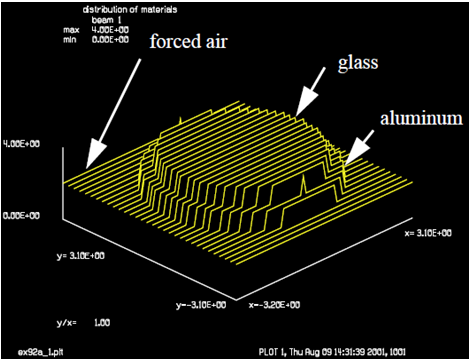
Figure 1. Initial material distribution
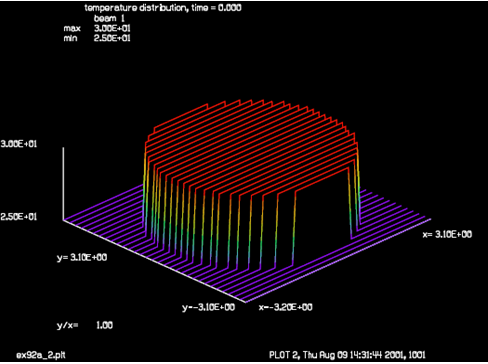
Figure 2. Initial temperature distribution
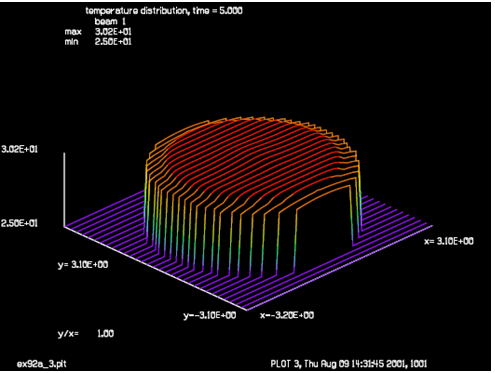
Figure 3. Temperature distribution at 5 seconds
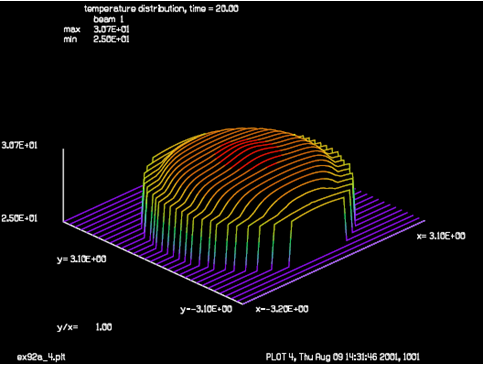
Figure 4. Temperature distribution at 20 seconds
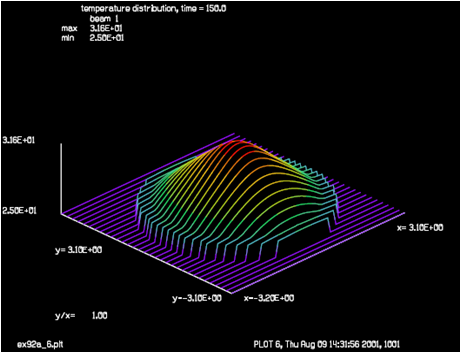
Figure 5. Temperature distribution at 150 seconds (steady state)

你对这篇帖子有什么看法?欢迎在评论区分享。