How thick metal can a laser welding machine weld?

Buyers often hope to obtain a clear welding thickness value, but the answer to this question is far more complex than imagined. The actual penetration depth of laser welding is not determined by a single factor, but by the combined effects of multiple variables such as power, material type, joint form, assembly accuracy, shielding gas ratio, wire filling amount, focal position, and welding speed.
From industry practice, handheld laser welding machines are most mature in the welding of thin plates within 10 millimeters. Among them, mainstream power ranges such as 1500W, 2000W, and 3000W each have their own economically applicable thickness ranges. If thicker plates need to be welded, a higher power automation system needs to be introduced, but with it comes a significant increase in process complexity, requiring more precise tooling and process design to support it.
Why Thickness Is More Than a Watt Number
When someone asks me, “How thick can this laser welder weld?” I usually answer with another question first. What material do you weld? Is it stainless steel, carbon steel, galvanized sheet, aluminum, brass, or copper? What is the joint type? Is it butt weld, lap weld, fillet weld, corner weld, or tube weld? What speed do you need? Is this a one-time repair or daily production?
This matters because metal thickness is not the only limit7. A clean 4 mm stainless steel butt weld can be easier than a bad 2 mm joint with a large gap. A 6 mm carbon steel test piece can look good in a demo, but the same thickness may fail in production if the parts are bent, dirty, or poorly fitted. Laser welding likes precision. It rewards good preparation.
Select power reference:
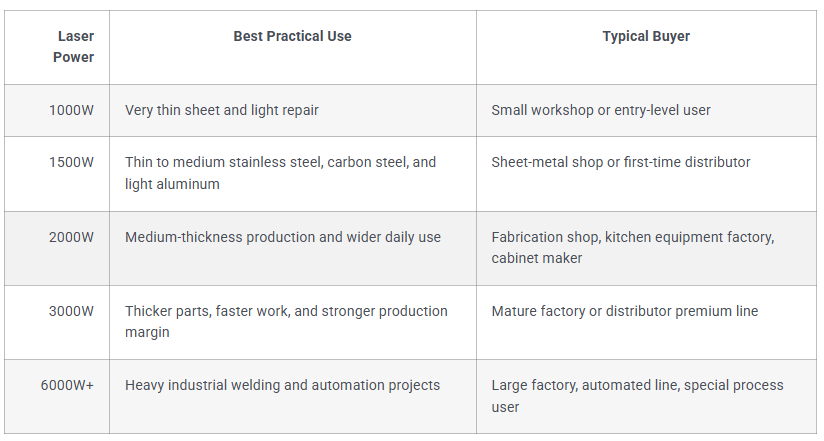
High-power laser welding can be excellent, but it is not the same as handheld daily welding8. It may need automation, fixtures, safety rooms, stable part feeding, and process control. For many workshops, 1500W to 3000W is already enough.
The real buying rule is simple. Match power to the most common job, not the rarest job. If 80% of the customer’s work is 1–4 mm stainless steel, a 1500W or 2000W laser welding machine may be the best business choice. If the customer often welds 5–8 mm steel and wants stable speed, 3000W is safer. If the customer welds heavy plate all day, then we should talk about a higher-power automated laser welding system.
Conclusion
I do not choose a laser welding machine by watts alone. I start with the real work. I check material, thickness, joint gap, speed, and production goal. For many sheet-metal jobs, 1500W to 2000W is the sweet spot. For thicker stainless steel, carbon steel, or faster production, 3000W is often the better choice. For heavy industrial work, 6000W or higher may be needed.

Cosa ne pensi di questo post? Condividi la tua opinione nei commenti.